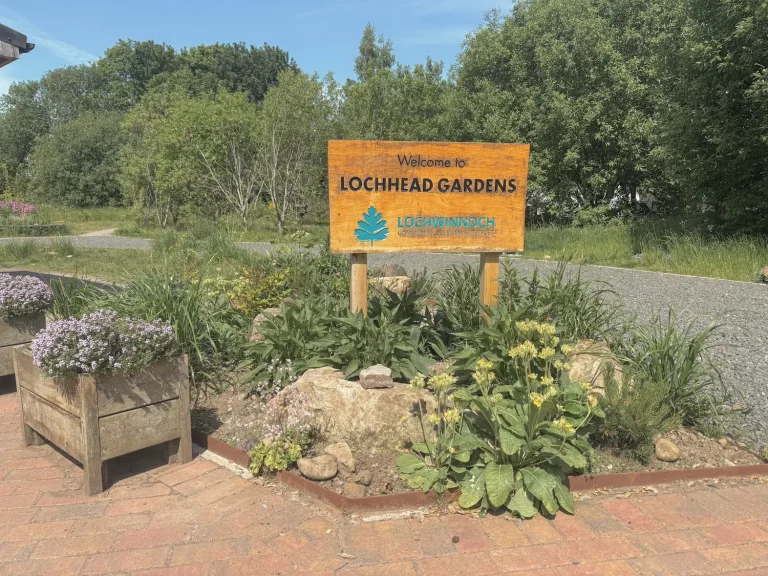


Did you know that Lochhead Gardens sits on land with an eventful past? The rich history of Lochhead Gardens started with the growth of furniture-making in Beith and Lochwinnoch, and the bustling cooperage.
We’re excited to share some of its stories as part of our journey to transform this space into a beautiful garden for everyone to enjoy.
The Rich History of Lochhead Gardens: Rise of Furniture Manufacturing
Back in the 1860s and 1880s, furniture-making became a major industry in the villages of Beith and Lochwinnoch. As a result, it replaced textiles as the main source of employment and brought prosperity to the region. One notable company, the Lochhead Cabinet Works, started trading in 1897.
In fact, this company actually rose from the ruins of Hunter Hamilton & Crawford, which had burned down a year earlier. After the fire, the partnership split up, and Hamilton & Crawford built a new, larger factory behind the Parish Church in Lochwinnoch. This factory, shown in an old photograph below, was an important hub of activity. It featured a main L-shaped building, likely the original 1880s structure, with an extension added around 1900. Nearby was what appears to be an engine house, powering the machinery that revolutionised furniture production.
Innovation and Growth
The development of new machinery transformed how furniture makers built their pieces. Previously, many components were crafted by hand, but advances in technology allowed rapid, efficient production. During this period, wages rose, and demand for furniture surged. In response, homeowners, hotels, and even steamship lines like the Titanic demanded more furniture.
The Rich History of Lochhead Gardens: The Cooperage Era
Fast forward to the 1950s, and a new chapter began with the opening of the Clyde Cooperage. Located behind Lochhead Cabinet Works, in an area known locally as “the Klondyke,” it formed part of the Robertson and Baxter Group. At first, only a few coopers worked in small workshops. But soon, the operation expanded.
The cooperage mainly repaired and made various types of barrels (called casks) that held liquids such as wine, whiskey, and bourbon. They produced barrels of various sizes: barrels (40 gallons), hogsheads (54 gallons), butts (110 gallons), and puncheons (110 gallons). They also repaired “Shooks,” which were flat American barrels shipped empty to save space and costs.
Work was quite skilled, and coopers worked under a “Paid by Results” system. This meant they earned bonuses based on how quickly they repaired each barrel. Over time, their workweek gradually shortened from 44 to 40 hours, similar to our current schedules.
From Industrial Site to Social Garden
Today, the rich history of Lochhead Gardens is being honoured through careful restoration and community-led transformation. What was once a wasteland is now being turned into a thriving village garden with a growing area, Men’s Shed, and a social space for everyone to gather. We’re preserving the heritage while creating something new for future generations.
Remembering Lochhead’s Rich History
Many residents, like Patrick Smith, remember working at Clyde Cooperage. Patrick started as an apprentice in January 1960 and still lives in the village today. The factory eventually moved to Viewfield, and Lochhead’s site was transformed into a machine shop before being demolished in 1984.
Looking to the Future
We hope you’ve enjoyed exploring the history of Lochhead Gardens. Our goal is to create a welcoming and memorable space for the community, honoring its rich past while looking forward to a vibrant future. Special thanks to Patrick Smith for sharing his stories and photos, which bring this history to life.
For more details about Lochwinnoch’s past, visit: Clyde Cooperage History
Read more about the project: Lochhead Social Garden